Starting a health sciences program, securing a campus job, or preparing for clinical rotations in Rocklin, California brings a flood of onboarding tasks. Chief among them is obtaining the correct resuscitation card. For students, faculty, and administrative staff at local higher education institutions like Sierra College and William Jessup University, deciding between Basic Life Support (BLS), Heartsaver CPR/First Aid, Advanced Cardiovascular Life Support (ACLS), and Pediatric Advanced Life Support (PALS) can be confusing.
The correct initial course depends directly on your academic major, degree path, or campus employment role. While pre-nursing students and allied health majors require professional healthcare provider training, student athletic trainers, resident advisors, and general campus staff usually need lay-responder certifications. Registering for the wrong class can lead to rejected clinical placements or unnecessary expenses. This guide breaks down exact academic and employment training requirements across Rocklin campuses to help you select the right certification course on your first attempt.
Key Takeaway: Nursing, EMT, medical assisting, and dental hygiene students must complete a professional BLS provider course before starting clinical rotations. Faculty, campus safety officers, childcare staff, and non-clinical student workers generally require Heartsaver CPR and First Aid training. Advanced credentials like ACLS and PALS are typically taken later during clinical specialization or professional practice.
Academic and Campus Job Training Requirements in Rocklin
Higher education campuses bring together diverse academic programs and student employment roles, each governed by different regulatory standards.
| Academic Program or Campus Role | Primary Certification Required | Target Patient / Care Group | Common Accepting Organizations |
| Nursing (RN/LVN), EMT, Dental Hygiene | BLS Healthcare Provider | Adults, Children, Infants | Hospitals, Health Systems, Licensing Boards |
| Medical Assisting, Phlebotomy, Radiography | BLS Healthcare Provider | Clinical Outpatients | Ambulatory Clinics, Imaging Centers |
| Child Development, Campus Daycare Staff | Pediatric CPR, AED & First Aid | Infants and Children | California EMSA, Child Care Licensing |
| Campus Security, Athletics Staff, Lab Assistants | Heartsaver CPR, AED & First Aid | Adults and Peers | Campus Safety, OSHA Compliance Teams |
| ICU, ER, or Pediatric Nursing Post-Grads | ACLS / PALS (Post-BLS) | Critical Adult or Pediatric Cases | Acute Care Hospitals, Emergency Departments |
Mandatory First Credentials for Health Science Majors
Students entering health science pipelines in South Placer County must meet strict clinical compliance deadlines before stepping onto hospital floors or outpatient facilities.
Pre-Nursing and Registered Nursing Students
If you are enrolled in nursing coursework at Sierra College or preparing to transfer to a BSN program, an American Heart Association BLS CPR Certification Course is mandatory. Clinical placement sites require BLS because it covers professional two-rescuer CPR, bag-valve-mask (BVM) ventilation, team resuscitation dynamics, and foreign-body airway obstruction relief. General community CPR cards are not accepted for clinical site clearance.
Emergency Medical Services and Fire Technology
Students pursuing EMT certificates or fire technology pathways must hold an active BLS card prior to starting field internships and ride-alongs. EMT curricula build directly on BLS skills, including manual ventilation and automated external defibrillator (AED) integration during pre-hospital transport.
Allied Health Programs: Medical Assisting, Dental, and Imaging
Students training in dental hygiene, phlebotomy, radiologic technology, or medical assisting must also secure BLS certification. Outpatient medical facilities and dental offices require these core resuscitation skills for all clinical personnel who interact directly with patients.
Non-Clinical Certification Requirements for Campus Staff and Educators
Not every student or employee on a college campus works in a hospital environment. Academic departments, athletic facilities, and campus services have distinct safety standards.
Campus Safety, Facilities, and Student Housing Staff
Resident advisors, campus security officers, housing coordinators, and laboratory staff require general CPR and First Aid training. These positions rely on Heartsaver courses to manage sudden cardiac arrest, environmental emergencies, bleeding, and allergic reactions on campus grounds until emergency medical services arrive.
K-12 Education and Child Development Majors
Students at William Jessup University preparing for teaching credentials or working in early childhood education need specialized training. California guidelines require teachers, daycare workers, and youth sports coaches to hold Pediatric CPR, AED, and First Aid certification compliant with California EMSA standards.
When Do ACLS, PALS, and NRP Become Necessary?
A common point of confusion for health science students is whether to enroll in advanced resuscitation courses before graduation.
Advanced Cardiovascular Life Support (ACLS)
ACLS focuses on advanced adult cardiac emergency management, including electrocardiogram (ECG) rhythm interpretation, intravenous airway management, and emergency pharmacology. Pre-licensure nursing students rarely need ACLS prior to graduation. Hospital employers typically sponsor or require ACLS training once you transition into specialized units such as the Intensive Care Unit (ICU), Emergency Department (ED), or Telemetry.
Pediatric Advanced Life Support (PALS)
PALS addresses pediatric respiratory distress, shock, and cardiac arrest algorithms. Similar to ACLS, PALS is an advanced credential intended for clinicians working in pediatric acute care, pediatric emergency rooms, or neonatal transport. Nursing students should focus on completing BLS first unless a specific post-graduate pediatric residency requires PALS prior to hire.
Neonatal Resuscitation Program (NRP)
NRP centers specifically on newborn assessment and resuscitation in the delivery room. This credential is required for neonatal intensive care unit (NICU) nurses, labor and delivery teams, and respiratory therapists specializing in newborn care, rather than entry-level health science students.
Choosing the Best Training Format Around Academic Schedules
Balancing lectures, lab hours, study groups, and work shifts requires flexible class options. Understanding available training formats helps you maintain continuous compliance without disrupting your academic term.
Blended Learning vs. In-Person Instruction
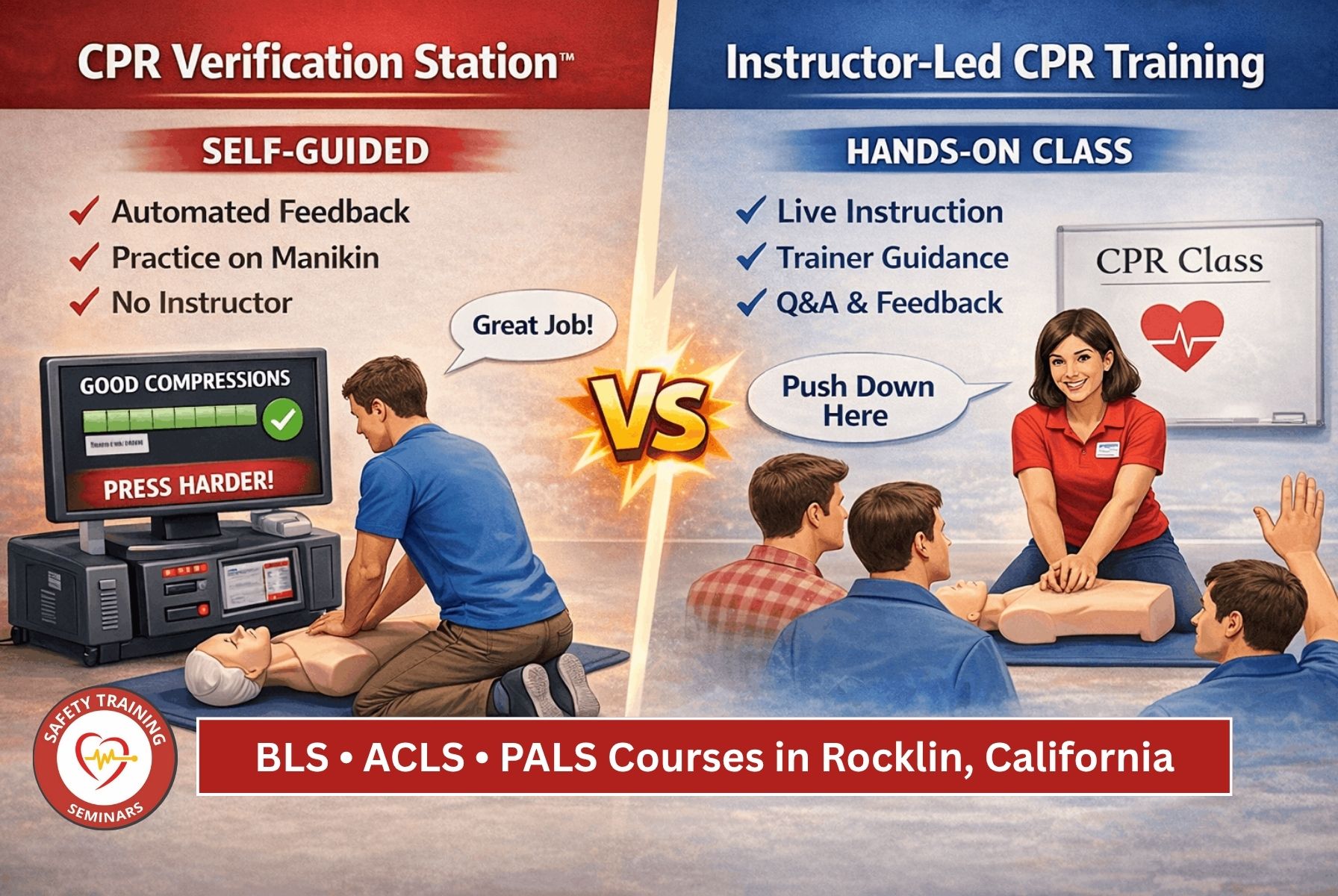
Traditional in-person classes offer hands-on instruction led by an instructor in a structured setting, ideal for students who prefer real-time coaching. Blended learning combines online cognitive modules with a brief, in-person skills evaluation. After completing self-paced online coursework, you attend a local testing center to demonstrate high-quality compressions and ventilations on feedback mannequins.
Verifying Physical Hands-On Requirements
Be cautious of non-accredited online vendors marketing “100% online” CPR certificates that do not require physical skills testing. Clinical placement coordinators, nursing departments, and healthcare employers strictly reject cards issued without in-person mannequin skills evaluation.
Serving Higher Education Communities in Rocklin and Placer County
Rocklin acts as a educational and suburban hub in South Placer County. Students, faculty, and working professionals across the area need accessible local options to maintain required health certifications.
Whether you are commuting along the Lonetree Boulevard corridor, traveling from neighboring Roseville, CA, coming down I-80 from Colfax, CA, or driving in from Lincoln, CA, access to a nearby training site eliminates long travel times during busy exam weeks.
Completing Your Requirements with Safety Training Seminars
For students and staff in Rocklin needing verified credentials, Safety Training Seminars provides regular local class availability.
Location Details:
Safety Training Seminars Rocklin CPR Training Center Address:
5701 Lonetree Blvd, Suite 126J, Rocklin, CA 95765
Located near local academic hubs, the Rocklin training center offers official American Heart Association BLS, ACLS, PALS, NRP, and Heartsaver CPR First Aid courses. The facility provides flexible scheduling options, including weekend times and quick blended learning skills checks, helping students fit certification around class schedules and clinical shifts.
Completing your training at an established physical site ensures your card is issued properly and meets hospital credentialing, academic clearance, and state licensing standards. You can easily view upcoming course dates and reserve your seat on the official training center page.
Frequently Asked Questions
Do nursing students at Sierra College need BLS or Heartsaver CPR?
Nursing students must take the professional BLS provider course. Heartsaver CPR is designed for non-clinical lay responders and will not be accepted by nursing departments or clinical hospital sites.
How long are BLS and Heartsaver CPR cards valid?
Official American Heart Association BLS and Heartsaver certifications remain valid for two years from the date of course completion, expiring on the last day of that month.
Can William Jessup education majors use BLS for teaching credentials?
BLS covers healthcare-level CPR, but California teaching credentials and childcare licensing require specific EMSA-approved Pediatric First Aid and CPR content. Education majors should verify whether their program requires the pediatric-specific module.
Where can students in Rocklin take their hands-on skills test?
Students can complete their required physical skills evaluations at the Safety Training Seminars course location in Rocklin, situated on Lonetree Boulevard.
What happens if I show up to clinicals with an expired BLS card?
Clinical coordinators will immediately pull you from patient care until an active card is presented. Maintaining continuous certification prevents missed clinical hours or academic program delays.
Final Steps for Rocklin Students and Campus Staff
Selecting the correct CPR certification comes down to whether your role involves direct patient care. Health science majors, pre-nursing students, and clinical workers should enroll in a BLS provider course, while non-clinical campus employees, coaches, and educators should opt for Heartsaver CPR and First Aid.
Always review your program handbook or syllabus to confirm exact provider requirements before enrolling. When you are ready to book your session, check available times at the local Rocklin CPR training location to secure your spot.