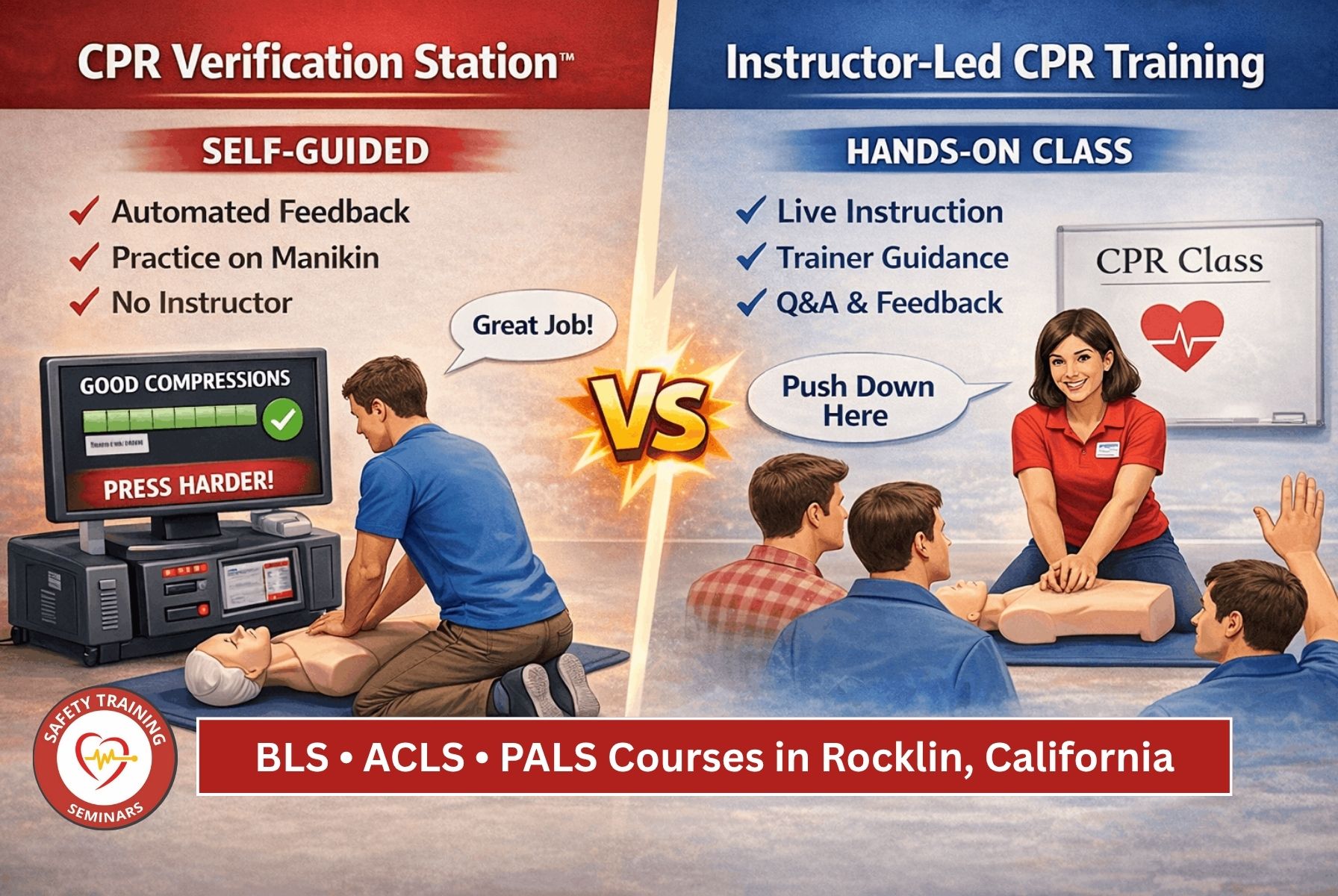
Finding time to sit through a five-hour continuous lecture can be tough for healthcare workers, student trainees, and safety officers balancing busy schedules along the Highway 65 corridor. In South Placer County, American Heart Association (AHA) Self-Guided Learning offers an efficient path to earning or renewing official credentials. This training framework splits your instruction into two distinct components: independent, web-based digital learning modules accessed on your own computer or tablet, followed by a brief, focused physical skills verification session in Rocklin.
Because different clinical roles, school programs, and corporate environments enforce specific training standards, selecting the correct course level is necessary before registering for an evaluation.
Key Takeaway: AHA Self-Guided Learning allows individuals to complete required cognitive coursework online independently while still satisfying mandatory in-person skills evaluation standards. The precise certification you need depends on your clinical or non-clinical job responsibilities and your organization’s compliance rules.
How AHA Self-Guided Learning Works
AHA Self-Guided Learning—often called blended learning or HeartCode® for advanced clinical disciplines—shifts traditional classroom lectures to an interactive digital portal without compromising the rigorous hands-on practice required for official certification.
- Self-Paced Learning: Candidates complete online training modules covering critical resuscitation protocols, interactive case scenarios, and core decision-making skills.
- Flexible Study: Learners can pause, review, and repeat difficult topics—such as cardiac arrest rhythms, ventilation ratios, or pediatric assessment steps—until they feel fully confident.
- In-Person Skill Verification: After finishing the web modules, participants schedule an appointment to demonstrate practical compressions, bag-valve-mask handling, AED operation, or advanced team management on specialized feedback equipment.
- Official Certification: Upon passing both the online cognitive assessment and the physical skill demonstration, candidates receive an authentic AHA course completion eCard.
This hybrid structure must not be confused with unaccredited “online-only” certificates. The American Heart Association requires physical performance evaluations to verify real-time mechanical skills like proper compression depth, rate, and chest recoil.
AHA Self-Guided Training Options Available in Rocklin
Blended learning formats cover the full range of AHA curricula, allowing medical professionals, emergency responders, school employees, and community members to fulfill their specific certification requirements.
Basic Life Support (BLS)
BLS serves as the core life safety standard across hospitals, urgent care centers, and outpatient facilities. The curriculum focuses on high-quality adult, child, and infant CPR, team-based resuscitation, bag-valve-mask (BVM) ventilations, relief of foreign-body airway obstructions, and automated external defibrillator (AED) usage.
- Who Typically Needs It: Registered nurses, medical assistants, dental hygienists, physical therapists, EMTs, radiologic technicians, and nursing students.
- Self-Guided Advantage: Clinicians complete theoretical learning at home, keeping their physical testing session short when scheduling BLS classes in Rocklin.
Advanced Cardiovascular Life Support (ACLS)
ACLS builds directly upon foundational CPR principles, focusing on adult cardiac arrest management, acute coronary syndromes, acute ischemic stroke, cardiac dysrhythmias, advanced airway management, and resuscitation pharmacology.
- Who Typically Needs It: Emergency department physicians, critical care nurses, paramedics, telemetry nurses, and acute care clinicians.
- Self-Guided Advantage: Healthcare providers review cardiac algorithms, electrical therapy protocols, and emergency drug dosages at their own pace before participating in hands-on team leadership assessments.
Pediatric Advanced Life Support (PALS)
PALS targets severe respiratory, circulatory, and cardiac emergencies in pediatric patients. The curriculum emphasizes the systematic pediatric assessment methodology, shock protocols, pediatric advanced airways, and team communication during pediatric cardiac arrest.
- Who Typically Needs It: Pediatricians, pediatric nurses, emergency department staff, pediatric dental specialists, and advanced emergency transport personnel.
- Self-Guided Advantage: Clinicians review age-based physiological nuances and pediatric medication dosages online before completing their physical skill evaluations. You can review scheduling details for local ACLS and PALS training options in Placer County.
Heartsaver CPR, AED, and First Aid
Heartsaver programs cater to non-healthcare roles that require official safety compliance. Modules cover basic CPR for adults, children, and infants, AED deployment, choking management, control of severe external bleeding, burn care, and first-aid responses for sudden medical illnesses.
- Who Typically Needs It: Teachers, daycare staff, youth athletic coaches, fitness trainers, industrial safety team members, construction leads, and family caregivers.
- Self-Guided Advantage: Non-medical workers complete background safety reading around their work hours, minimizing spent time during hands-on skill practice.
Selecting the Correct Certification Level
Registering for an incorrect course can result in delayed onboarding or non-compliant credentials. Use this comparison table to identify the training level that aligns with your role.
| Course Level | Primary Target Audience | Key Skills & Topics Covered |
| BLS | Nurses, medical/nursing students, dental professionals, EMTs | High-quality CPR, BVM ventilations, AED use, multi-rescuer team response |
| ACLS | Emergency physicians, ICU/CCU nurses, paramedics, code teams | ECG interpretation, resuscitation pharmacology, stroke/ACS care, team dynamics |
| PALS | Pediatric nurses, emergency department staff, pediatric specialists | Pediatric assessment triangle, pediatric shock, respiratory emergencies, pediatric arrest |
| Heartsaver CPR/AED | Educators, childcare workers, fitness professionals, office leads | Adult, child, and infant CPR, AED operation, choking relief |
| Heartsaver First Aid | Industrial workers, construction crews, coaches, community members | Bleeding control, shock management, burn care, environmental trauma |
Note: Training requirements are established by individual employers, state boards, and academic institutions. Always confirm your exact course level requirements with your supervisor or school advisor before registering.
Comparing Training Formats: Self-Guided vs. Classroom vs. Online-Only
Knowing the operational differences between learning delivery models helps ensure your final credential will be recognized by regulatory agencies and employers.
- AHA Self-Guided (Blended) Learning: Combines remote web coursework with an obligatory in-person physical assessment. It fulfills requirements established by OSHA, hospitals, and academic accreditation organizations because manual mechanical proficiency (compression depth, rate, recoil, and mask sealing) is evaluated directly.
- Traditional Classroom Instruction: Involves attending a fixed-schedule, instructor-led group presentation at a designated facility. This format works well for learners who prefer structured group discussions and real-time verbal instruction throughout the cognitive phase.
- Unaccredited “Online-Only” Cards: Various online vendors issue instant certificates without requiring physical skills testing. Warning: Healthcare systems, school districts, and state licensing boards routinely reject online-only certificates because physical skill competency cannot be verified through a web screen.
Local Training Access in Rocklin and Surrounding Placer County
Situated in South Placer County near Roseville, Lincoln, and Granite Bay, Rocklin is a growing hub for healthcare professionals, suburban school districts, and expanding business parks. The area is home to Sierra College, making it a high-density location for nursing students, emergency medical trainees, and allied health candidates completing required health credentials.
For clinical personnel working varying shifts at regional medical centers or educators managing busy school schedules, traditional all-day training can be difficult to manage. AHA Self-Guided Learning resolves these schedule constraints by allowing local learners to complete their digital modules at home or between shifts, limiting local travel to a short, convenient skills evaluation appointment along Lonetree Boulevard.
Completing Your Assessment with Safety Training Seminars
For learners looking to finish their hands-on skills testing, Safety Training Seminars provides structured AHA evaluation appointments.
Safety Training Seminars Rocklin CPR Training Center Address:
5701 Lonetree Blvd, Suite 126J, Rocklin, CA 95765
Students and workplace employees seeking foundational certification can view available testing slots on the BLS and CPR classes in Rocklin registration page. Clinical personnel requiring advanced credentials can check open evaluation times through the dedicated ACLS and PALS courses in Rocklin portal.
Frequently Asked Questions
Is an eCard earned through AHA Self-Guided Learning identical to a traditional classroom card?
Yes. Upon successful completion of both the online cognitive coursework and the physical skills assessment, you receive an official American Heart Association eCard. It carries the exact same recognition with employers, healthcare facilities, and licensing boards as a card obtained through a traditional classroom course.
Can students or professionals commuting from nearby cities like Roseville or Lincoln use the Rocklin facility?
Yes. Residents and healthcare personnel from neighboring communities—including Roseville, Lincoln, Granite Bay, and Loomis—can complete their online coursework at home and reserve their hands-on skills evaluation at the Rocklin center.
What do I need to bring to my in-person skills evaluation session?
You must bring a printed or digital copy of your AHA online course completion certificate. Instructors cannot conduct your physical skills verification without verifying that you successfully passed the digital cognitive component.
How much time should I expect to spend at the physical skills appointment?
While online cognitive modules require 1 to 4 hours depending on the course (BLS, ACLS, or PALS), the hands-on evaluation is focused and quick. Because your theoretical knowledge was confirmed online, the physical skill demonstration usually takes approximately 30 to 45 minutes.
Will local nursing programs or medical facilities accept a CPR card that was issued online without a skills test?
Generally, no. State licensing agencies, nursing programs, and healthcare systems strictly require a hands-on physical demonstration of chest compressions, ventilations, and AED operation. Certificates issued without in-person skill verification are usually turned down during onboarding.
Summary and Next Steps
AHA Self-Guided Learning provides a flexible, scientifically sound pathway to earning or renewing your life safety credentials without requiring hours of continuous classroom sitting. By combining web-based study with a brief physical skill verification, you maintain complete control over your study schedule while satisfying mandatory workplace and professional standards.
Before enrolling, confirm the specific course level required by your employer, school coordinator, or licensing board. Once confirmed, complete your online coursework independently and schedule your practical skills testing at an authorized local center to receive your official course eCard.