Balancing rigorous academic schedules with clinical prerequisites requires careful planning, especially when securing your basic life support credentials. Nursing students at Sierra College, allied health majors at William Jessup University, and local healthcare workers frequently face strict deadlines to obtain or renew their official certification. Finding an accessible training site in Placer County that fits around lectures and hospital rotations can be challenging.
This guide clarifies who needs a basic life support card, what skills you will practice, how to select a course that satisfies academic or clinical standards, and where to find local instruction in Rocklin.
Key Takeaway Most healthcare programs, clinical sites, and medical facilities require an American Heart Association (AHA) Basic Life Support (BLS) certification with a hands-on skills evaluation. Online-only cards are rarely accepted by schools or hospital networks in the Rocklin area. Choosing a blended format with an in-person skills verification ensures full compliance while saving valuable study time.
Who Needs BLS CPR Certification in Rocklin?
A Basic Life Support card is designed specifically for healthcare providers and public safety personnel. Unlike general workplace CPR, BLS focuses on team dynamics, high-quality chest compressions, multi-rescuer coordination, and advanced airway support.
In the Rocklin and South Placer region, several specific groups must maintain an active BLS card:
- Sierra College Nursing & Allied Health Students: Enrollees in the Registered Nursing (RN), Vocational Nursing (LVN), or Medical Assisting programs need valid CPR certification before starting clinical rotations at regional hospitals.
- William Jessup University Kinesiology & Healthcare Students: Students entering pre-allied health, athletic training, or community health practicums must show proof of basic life support competency.
- Registered Nurses, LVNs, & CNAs: Staff working in ambulatory clinics, outpatient surgery centers, home health agencies, and long-term care facilities need regular two-year renewals.
- Emergency Personnel & First Responders: Firefighters, EMTs, paramedics, and law enforcement officers servicing Placer County require continuous basic life support validation.
- Dental Professionals: Dentists, hygienists, and dental assistants across local practices must maintain BLS certification for state licensure compliance.
Non-clinical staff, childcare workers, and teachers usually need a general CPR and First Aid course rather than the BLS credential. Always verify with your department head or employer before enrolling.
What Skills Are Covered in a Healthcare Provider BLS Class?
A professional BLS course teaches systematic assessment and rapid intervention for cardiac arrest, respiratory distress, and airway obstructions across adult, child, and infant patients. Training focuses on evidence-based resuscitation techniques designed to maintain perfusion to vital organs until advanced cardiac life support arrives.
High-Quality Chest Compressions
Compressions form the foundation of effective CPR. You will practice maintaining a rate of 100 to 120 compressions per minute at an adequate depth (at least 2 inches for adults, about 2 inches for children, and 1.5 inches for infants), allowing full chest recoil after each compression.
Automated External Defibrillator (AED) Use
Defibrillation within the first few minutes of collapse significantly increases survival rates. Classes cover rapid AED pad placement, analyzing heart rhythms, and delivering shocks safely while minimizing pauses in chest compressions.
Ventilation Techniques
You will learn single-rescuer and two-rescuer ventilation using pocket masks and bag-valve-mask (BVM) devices. Proper technique involves opening the airway using a head-tilt/chin-lift or jaw-thrust maneuver while monitoring for visible chest rise.
Multi-Rescuer Team Dynamics
Hospital and emergency resuscitation relies on coordinated teamwork. The curriculum emphasizes clear communication, designated team roles, and seamless transitions between compression cycles to reduce responder fatigue.
Airway Obstruction Management
Students practice physical interventions to relieve choking in conscious and unconscious adults, children, and infants.
Blended Learning vs. Full In-Person Classes
Healthcare students and working professionals often struggle to clear four to five uninterrupted hours for traditional classroom instruction. Blended learning offers an efficient alternative that preserves hands-on skill standards.
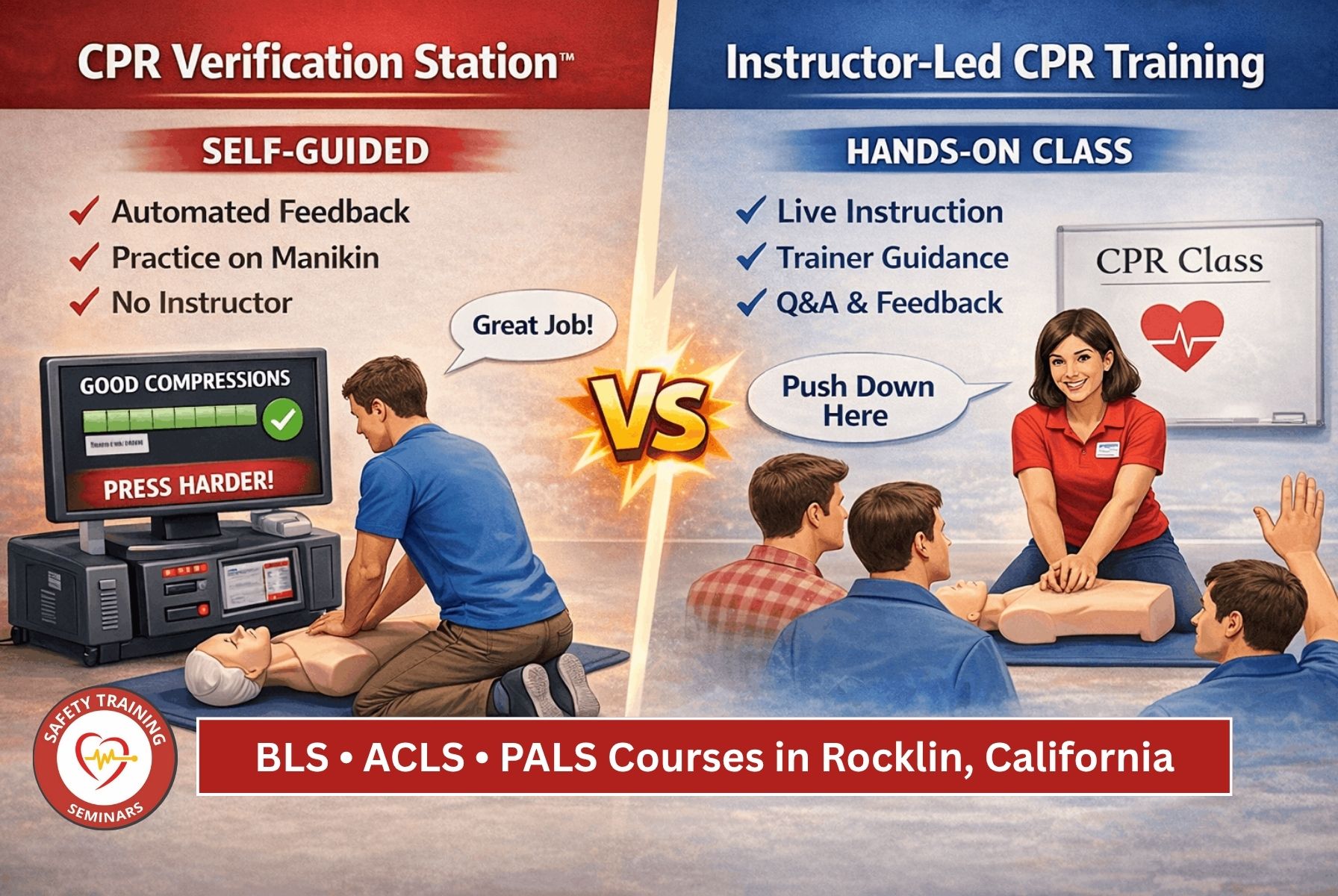
Blended learning allows you to complete the cognitive portion on your computer or tablet when your schedule permits. After completing the online module, you attend a brief in-person skills verification session to demonstrate compression depth, ventilation technique, and AED application on feedback manikins.
Both formats issue the exact same official AHA BLS Provider eCard. Clinical programs and hospital networks do not distinguish between blended and full classroom completion, provided an instructor verifies your hands-on proficiency in person.
Common Certification Pitfalls Students Should Avoid
When seeking a BLS CPR Certification Course, selecting the wrong class format can waste time and money. Nursing programs and hospital human resources departments apply strict accreditation criteria.
- Accepting 100% Online Cards: Unaccredited websites often promise complete online certification without a hands-on evaluation. Major employers, medical boards, and college nursing departments consistently reject these certificates.
- Selecting the Wrong Course Level: Enrolling in a layperson CPR course instead of a BLS Provider class will leave you lacking necessary clinical skills like bag-valve-mask ventilation and team resuscitation dynamics.
- Waiting Until the Last Minute: Clinical placements at regional facilities require active certification before you step onto the floor. Processing times and limited class availability near semester deadlines can cause compliance delays.
- Forgetting Card Renewal Schedules: BLS credentials remain valid for two years through the end of the issue month. Tracking expiration dates prevents sudden gaps in your clinical eligibility.
Attending CPR Training in Rocklin, CA
Having a dedicated local training facility makes keeping up with certification requirements much easier for students, faculty, and clinical professionals living in South Placer County.
Safety Training Seminars operates a local facility positioned to serve Sierra College and William Jessup University students, as well as healthcare providers throughout the region.
Local Center Location: Safety Training Seminars Rocklin CPR Training Center Address: 5701 Lonetree Blvd, Suite 126J, Rocklin, CA 95765
Located off Lonetree Boulevard, the center offers frequent morning, afternoon, and evening scheduling options. This convenient setup allows students to complete their practical skills evaluation between classes, clinical shifts, or laboratory hours.
If you live or work in nearby communities, you can also explore options through:
- American Heart Association BLS classes in Roseville
- Local CPR certification options in Lincoln
- Healthcare provider CPR training in Colfax
Frequently Asked Questions
Does Sierra College accept blended BLS courses for nursing clinicals?
Yes, Sierra College accepts American Heart Association BLS credentials obtained through blended learning. The online module must be paired with an official, in-person skills evaluation conducted by an authorized instructor.
How long does the BLS certification remain valid?
BLS certification is valid for two years. Your card remains active through the final day of the month in which it was issued. You must complete a renewal course before that expiration date to keep your credential active.
What should I bring to my in-person BLS skills session?
Bring a printed copy or digital screenshot of your completed online AHA cognitive course certificate. Wear comfortable clothing that allows you to kneel easily on the floor next to training manikins.
What is the difference between BLS and Heartsaver CPR?
BLS is designed for healthcare professionals and covers two-rescuer resuscitation, bag-valve-mask ventilation, and advanced clinical scenarios. Heartsaver CPR is designed for non-clinical audiences, such as teachers, coaches, construction workers, and daycare staff.
Preparing for Your CPR Certification Session
Securing your BLS card does not have to disrupt your study schedule or work commitments. By selecting an accredited blended learning format, you can complete your coursework online and finish your hands-on verification quickly right here in town.
Review current class availability, verify your school or workplace requirements, and reserve your hands-on skill session at the Safety Training Seminars course location in Rocklin to keep your healthcare credentials fully up to date.